2025 S Corporation Tax Benefits: Avoid Double Taxation and Maximize Deductions
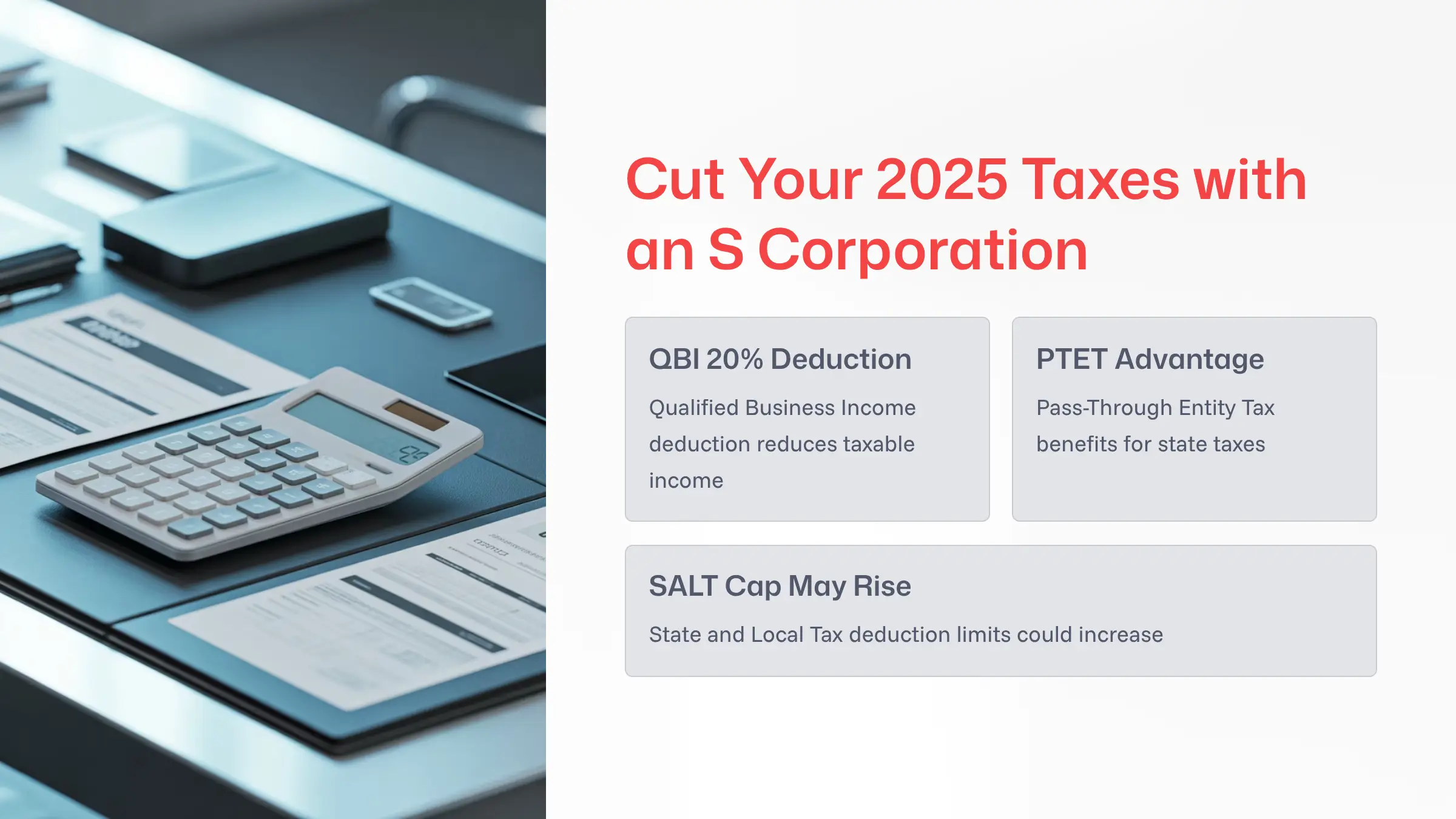
An S Corporation combines limited liability with pass-through taxation.
For 2025, powerful tools like the QBI deduction and PTET, plus a possible SALT cap increase,make S Corps a standout choice for small businesses and professional practices.
1) What Is an S Corporation?
An S Corporation (Subchapter S) is a corporation that elects pass-through taxation.
Income, deductions, and credits flow to shareholders and are taxed on their individual returns—avoiding the
double taxation faced by C corporations.
A New York physician converted from a C corp to an S corp, eliminating dividend-level tax and trimming thousands in annual taxes.
2) 2025 Updates & New Opportunities
For 2025, three developments stand out for S Corps: the QBI deduction,
PTET elections in many states, and discussion of a possible increase to the SALT deduction cap.
The SALT item is not finalized; monitor updates before filing.
- QBI (§199A): Up to a 20% deduction on qualified business income for eligible owners.
- PTET: State-level pass-through entity taxes can mitigate the federal $10,000 SALT cap by paying at the entity level.
- SALT cap: Lawmakers are considering an increase (e.g., up to $40,000). Treat as a possibility until enacted.
A New Jersey consultant elected PTET for the S corp, shifting state taxes to the entity and combining it with the 20% QBI deduction—saving roughly $8,000.
3) Key Tax Advantages
① No double taxation — shareholders, not the corporation, pay the tax.
② Salary vs. distribution planning — pay a reasonable salary (subject to payroll tax) and take remaining profits as distributions (generally not subject to FICA/Medicare). Excessively low salaries risk IRS reclassification.
③ Loss deductions — deductible on owners’ returns up to their stock/basis limits.
④ Single-tier taxation on asset sales — gains pass through to shareholders rather than being taxed twice.
A salon owner reduced W-2 wages from $60,000 to $42,000 and took $18,000 as distributions, cutting payroll taxes by about $3,000 while maintaining reasonable-compensation support.
4) LLC vs. S Corporation
LLCs (taxed as partnerships) offer flexibility, but owners often pay self-employment tax on all earnings.
S Corps can reduce that burden via salary/distribution planning—though S Corps have tighter ownership and stock-class rules.
| Category | S Corporation | LLC (Partnership) |
|---|---|---|
| Tax structure | Pass-through (individual) | Pass-through (individual) |
| Self-employment tax | Reduced via distributions | Generally applies to all earnings |
| Ownership limits | Up to 100 eligible U.S. shareholders | No limit |
| Flexibility | One class of stock; stricter rules | Highly flexible profit sharing |
Two LLC partners paid SE tax on all income. After electing S-corp status and setting reasonable salaries,
distributions lowered their combined tax burden by ~15%.
5) State-Level Planning in 2025
- PTET elections (where available) can offset the federal SALT cap by paying state income tax at the entity level.
- SALT cap: an increase is being discussed but is not yet final—watch for enactment details and state conformity.
- Asset transfers may trigger sales/use tax; structure moves carefully.
- Domicile & residency affect state income, estate, and local taxes for both the company and shareholders.
A Florida S corp owning New York property used entity structuring to limit NY estate-tax exposure and streamline future exits.
6) Final Thoughts
The S Corporation remains one of 2025’s most tax-efficient structures for small businesses.
With QBI, PTET, and a potential SALT cap expansion, owners can unlock meaningful savings.
The IRS scrutinizes reasonable compensation, so partner with an EA/CPA to set salaries and distributions correctly.
🔗 Related Articles
🔗 Official resources:
IRS — S Corporations Overview
핑백: 2025 Tax Tips: Master Your Filing Status for Maximum Savings
핑백: Understanding Business Travel Expense Deductions in 2025
핑백: 2025 Guide to Trusts That Qualify as S Corporation Shareholders
핑백: 2025 S Corporation Eligibility Guide
핑백: Understanding S Corporations in 2025